Wednesday, June 4, 2014

Ladyslippers and Others

Pink Ladyslipper leaf
Yesterday's rain has revived both the garden and the gardener! It was getting pretty dry around here, and the heat the last few days didn't help. The garden was starting to look more than a bit wilted, and the gardener, being something wilted herself, was starting to think more about cool glasses of wine than about weeding. But today we are both full of enthusiasm again.

The Pink Ladyslippers, Cypripedium acaule, are gorgeous this year. Last year's good growing and the cold winter seem to have done them good. I have clumps of Pink Ladies in several places here - beside the Beaver Pond on one side of the ridge, in a hollow right on the ridge, and along the Marsh on the other side of the ridge. The ones beside the Marsh are the easiest to get to, being quite close to the house and on a trail hardly obstructed at all by blow-downs (only one tree, and it easy to step over). It started about 6 years ago as this one leaf. I'm surprised I even saw it, it looks so much like the Wild Lily-of-the-Valley leaves all around.

Earlier this month I saw that the clump now had six lovely buds, all held demurely above the foliage.

(That's another blow-down behind them. A large Balsam Fir went down several years ago. Following my policy of ignoring all path obstructions whenever possible, I have left it alone. It is now getting pretty punky, in fact when I stood on it it squooshed a bit. Another year or two and it will be compost.) 
 

The flowers are still not quite at their peak, but have turned pink and are starting to straighten up. In a day or two they'll be world-class.

As are the mosquitoes, but we won't whine about them. Not today.

Cypripedium arietinum
The Yellow Ladyslippers are also doing well, or maybe I should say, are doing better. I have been puzzled as to why my plants didn't seem to be doing all that well and finally realized they were suffering from fungus problems. I'm not a scientist so cannot be certain, but the leaves didn't look healthy and the plants were getting smaller..... then I read somewhere that some plants that like acidic soil can be badly attacked by fungal diseases in neutral or basic soils, and a little 'aha' went off. I mulched with lots of pine needles and planted the 2 new plants I got nearer the Marsh where the soil is very acid. And it is working! The Marsh ones are looking vigourous (no flowers this year, but several stems and good big leaves) and the ones in the Sampler Gardener have at least one flower each. Whew.

My one plant of Cypripedium arietinum, Ram's-head Ladyslipper, is blooming as well. Tiny, only about 8" high, but cute! And notice the healthy leaves.


The Showy Ladyslippers, Cypripedium reginae, are still only shoots. Tall shoots, but still just shoots. They'll take another couple of weeks to bloom.

Elsewhere in the garden, the old Heirloom Irises are open. I rather like them. The flowers are much smaller than the big showy Beardeds available to us nowadays, but they have their own charm, and indeed they fit into a border or bed rather better than the prima donnas do. They look good from a slight distance for a week or more. The more modern Irises are better admired closer up, and they need the faded blooms removed before you do so. I don't know the names of any of these, but here's a sample of the flowers to enjoy.

 Anybody want to swap some? Leave a comment, and I'll let you know when I divide mine, probably in late July. Apparently there is an attractive white one.... well, apparently my Gardener's Greed has revived too!

Monday, May 26, 2014

Garden Walkabout

One of the pleasures of a garden is the morning walk-about. It's best done as an hour stolen from the morning before starting work, with a mug of good coffee and a faithful following hound. If the walk-about were an event in itself, you would have to think about the jobs you see that need doing, or the problems you note that need to be solved, but since the hour is being borrowed from the work day, you aren't on duty and can't be expected to think about those things.

Shall we walk?


Let's start beside the house, where the crabapple trees are having their 15 minutes of glory. The red peony under the middle tree is finally beginning to bloom - it has been in the garden for years and only now is it blooming. It started as one stem, about two inches high, so I guess it needed to grow up.


The dwarf bearded irises along the path to the Hillside are gorgeous. How did someone who decided not to have any bearded irises end up with so many? My excuse is that I had decided not to have tall bearded iris, and these are not tall. I keep finding them in pots at the nurseries (and stores) in the spring and fall for the colours, the satiny texture of the petals, the amazing form of the beards. I counted the different ones, and, well, never mind.
The path takes me around the Studio and into the Rockery. A friend gave me a piece of a Bloodroot she discovered which has yellow leaves. The flowers are the usual white, but the leaves are spectacular. The Forget-me-nots put themselves here, with their usual unerring instinct for where they suit. Forget-me-nots, like some lucky people, have Style. Thank you, Lee!


Another plant with good instincts is an ornamental strawberry, called, I think, 'Pink Panda'. A dumb name, but a nice, if stubborn, little plant. The flowers are quite large, and there are a few all summer long. It does however, insist on growing where it wants to grow, not necessarily where you might want it. I planted it at the top of a small wall, and it moved to the bottom. I put a piece in the front of a small bed of pale yellow daffodils, and it moved to the back.... fine, I'll just enjoy it wherever I find it.


Continuing on my way around, I stopped for a minute to give one of the little self-seeded White Spruces a (metaphorical) pat on the head. They are headed to brief (but brilliant) careers as Christmas Trees, and I'm happy to see how bushy they are getting. The new growth is bright green and a bit droopy.

 You'd be droopy too, if you had to grow 6 inches in about 3 days.


Everywhere, the ferns are springing up. They tend to rise later than many of the spring flowers, so sometimes I get a bit nervous and poke around carefully at the bases of last year's stalks to make sure there are tightly coiled green fiddleheads  waiting there. The new growth is unbearably green, so tender, so hopeful. The whole Sampler Garden, like the woods around it, is bursting with new growth.

I can even find something good to say about Ajugas - when they bloom, they do set off the new ferns beautifully .


Well, our hour is up; I'm back at the Studio. My coffee mug is empty, but my heart is full.

Tuesday, May 13, 2014

Adventures

I think I'm a person who has adventures. At least, they seem like adventures to me. They may not to you, if you think it's only an adventure if it takes place in some hard to reach locale and involves camels.... but on the other hand, have you seen my driveway? And if you squint at my cat just right.....

Yesterday was such a beautiful day I decided to get my vegetable patch ready for planting. I've downplayed veggies the last few years because the chipmunks destroyed everything I did. If I planted peas, they simply ate them. Beans, they waited until they germinated and then ate them. The only thing they didn't eat was broccoli, and there was so much broccoli that by the end of the summer I was halfway wishing they had eaten it. All tomatoes had bite marks, cucumbers were pre-peeled; it was hopeless. But there are fewer chippies since I stopped feeding the birds so I think I'll try again.

My veg patch is pretty small, only 20' by 20', but the soil is good and it is in the sun, so things do really well there. All it needed was some thistle seedlings removed and a bit of fluffing up with the garden fork.

So there I was, bent right over shaking the soil off a thistle root, when I felt something tap me, rather sharply, on the back. Naturally I jumped but when I tried to straighten up I couldn't! It took me a second or two to realize I was stuck in the branches of a dead Balsam Fir. These trees don't live long, and all the ones along the marsh are slowly dying and being replaced by cedars and maples. There are only a few left beside the veg garden, and one of them was quite dead on top. The gusty spring wind had broken the top off and blown it onto my back!

How many people do you know who need to wear hardhats and other protective gear just to work in their garden? And that's without even any camels around.

Then today, this morning, there was a snake in the Studio. Just a small snake, a Northern Water Snake, about 2 feet long and less than an inch at its widest. It was more or less curled up, with the end of its tail sticking straight up in the warning position. These snakes don't have rattles, but they do shake their tails as warning behavior. My cat, Pepper, was swiping a paw at it, just far enough away not to actually connect, and the snake was darting its head at her, also just far enough away not to connect.

How do you get a snake out? I put a pail over it and then pushed a cardboard underneath, scooping snakie into the pail. Then I walked it over to the edge of the marsh and said 'Bon Voyage' and tossed. It seemed to appreciate the sentiment.


Another adventure is coming up, too. Next Sunday is my Wildflowers Day here. This spring has been so late that things are still just starting, but the last few days have been lovely and warm and the spring flowers are just leaping ahead. The Trilliums ought to be at their best on Sunday. I'll have some native plants in pots for sale (very cheap!!) although I can't tell for sure yet what has and what has not survived the winter.


Do come out, if only for a visit! And maybe you'll have the adventure of finding a plant you have been looking for, and I'll have the adventure of meeting another gardener..... see, life is full of adventures!

Friday, May 2, 2014

Trailing Arbutus, a Shy Shrub

Years ago when I was first getting interested in our native plants, I was lucky enough to find some antique books about them, one of which was Mrs. William Starr Dana's 'To Know the Wildflowers'. Her sometimes exaggerated prose made me smile a bit, but on the whole I found she had much to teach me.

One of the plants she discusses is the Trailing Arbutus, or Epigea repens, whose "waxy blossoms and delicious breath are among the earliest prophecies of perfume-laden summer".

I'll spare you the two pages of poetry excerpts that follow.

The point I want to make, though, is that these older books, and the newer field guides as well, led me astray about this plant. From the enthusiastic descriptions and the pretty line drawings, I got the impression of a substantial plant. Since the later books also called it a 'shrub', I thought it was probably like a large blueberry bush..... and I looked for something that size. Needless to say, I never found it.

Only when we moved to Constance Bay did I finally meet Trailing Arbutus. You can imagine my surprise when I discovered it was a prostrate or trailing shrub, with its branches running along the ground and the leaves held horizontally just above the duff layer. Of course, as soon as I saw it, the images in the books clicked into place - all that was needed was a size adjustment!

And, in fact, Trailing Arbutus is everything Mrs. Dana said. Fragrant, fresh, sturdy but delicate, ephemeral, a bit mysterious, totally beguiling. She makes much of it being known as the Mayflower, and being a symbol of the hope felt by the early settlers after the hardships of their first winters n the New World.

I have it now, here at Pine Ridge, from cuttings taken from plants from Constance Bay. In fact, the only other place I have seen it is in Algonquin Part, growing in a very unexpected habitat on top of some dry and exposed rocks. As I mention in the 'Know and Grow' page, Trailing Arbutus is not that easy to propagate. Seeds are very hard to get, and cuttings may or may not root. In three years of trying, I had good rooting only once. That time, I left the cuttings outside over winter as instructed (in another classic, Lincoln and Timmie Foster's 'Pleasures and Perils of the Rock Garden'), covering the flat with a clear plastic lid to protect it. What I didn't think of was that the snow would weigh it down..... the lid collapsed, the plants were squashed flat.... luckily they must have been an obstinate crew because most of them survived, and most of them are now growing in my woods. I put them under tall White Pines, on the north or eastern sides of the kinds of small mounds these woods seem to have, and they are doing well. One funny thing, they have all grown downwards. For some reason, I seem to plant things part way up slopes, expecting them to grow both upwards and downwards, and they never do.

Look for Trailing Arbutus to be in bloom now. The cool slow spring has set them back slightly, but the plants here at Pine Ridge are ready to open their buds.

We'll let Mrs. Dana have the last words: "... these brave little blossoms, struggling through the withered leaves, brought a message of hope and courage to the heroic heart of the Quaker poet...(Whittier) who called them 'The first sweet smiles of May'. Quite.

Thursday, April 17, 2014

Snow....drops

I hope you have snowdrops.

If you do not, get some. They are just about the only thing that will bloom in time to save the gardener's sanity while she waits for the snow to be gone and the ground to be dry enough for actual gardening to begin. Without Snowdrops, the outlook for future normalcy in the gardener would be grim.

In our area, we can grow all three of the main species. There are about 20 more different species, but sadly they are just not available here so I don't know whether they are hardy here.If you ever have a chance to get bulbs, or more likely, seeds, of any of the others, take it, and remember your friends.

Galanthus nivalis

The ones we can get and which I know do well here are Galanthus nivalis, G. elwesii, and G. woronowii.

G. nivalis is the one that causes Snowdrop fever in susceptible gardeners. There are too many varieties to count, there are clubs for the afflicted, there are official registries, competitions, books.... if this sort of obsession appeals to you, a quick on-line search will make you very happy. Not that the search will be quick because of course if you are smitten with Snowdrop Love, you will spend the rest of the day following the many, many links. You'll have a great time, and maybe by the time you are done the snow will be gone.

G. nivalis is also the smallest and daintiest of the three. It is the one that makes us kneel in the wet leaves so that we can get close enough to admire the purity of the outer petals and the brilliant green markings on the inner ones.

G. nivalis has style.

G. elwesii is slightly larger in all ways: the flowers are a bit larger, the leaves are wider and taller, the bulbs are larger too. It is every bit as beguiling as G. nivalis.

All the Snowdrops are of course bulbs. The conventional wisdom about growing them is to move them 'in the green', that is, to move and propagate them by digging them up with a good sod and re-planting them immediately. Sadly, we cannot often do this as we are forced to order the bulbs in the summer and they will arrive, dry, in August. A good source (in fact the only source I know of, not counting little bags of dried-up bulbs sold by big-box stores at strange times) is Botanus. They have a fine on-line catalogue, very suitable for more time-wasting while you wait for the snow to go. Ask for more than a few bulbs as they will not all grow but you will end up with enough. They spread.


Galanthus woronowii

Last, and the opposite of least, is G. woronowii. It has decidedly wide leaves, but the flowers are as delicate as those of G. nivalis.

All the Snowdrops are trouble-free and need no special care. The foliage goes dormant without calling attention to itself and once established, the plants will return every year, just when you really need them.


Monday, April 7, 2014

Getting Involved

Heads Up!

As gardeners, we do have a tendency to keep our heads down. We get so involved with our own gardens, we sometimes forget to look up and see what is going on around us.


Here are a couple of interesting garden-related events happening soon which are worth looking up for. Best of all, I have a nifty give-away for one of them!

The Canadensis Botanic Garden Society is, as I mentioned a post or two ago, bringing Alexander Reford to Ottawa to talk about The International Garden Festival held at the Reford Gardens. This world-renowned garden located near the mouth of the St. Lawrence River was started by his great-grandmother Elsie Reford and is now open to the public in the summer months. It is a most unusual garden, begun as a private garden and now famous both for its scenic beauty and for its impressive stand of the Blue Poppy, Meconopsis betonicifolia. The lecture is being given twice, both on the evening of Thursday, May 1, first at 6:00 pm, and then again starting at 8:00 pm. Sort of like two dinner sittings on a cruise ship!

There is lots of information about this event on their website including details such as the location of the lecture (Cereal Barn, Experimental Farm, Prince of Wales Drive), parking, cost, etc. etc.

Now, I have 2 tickets to the 8:00pm lecture to give away!

All you have to do to win them is.....  leave me a comment or send me an email saying which native plant you would like to see featured next in my Know and Grow box. Next Sunday evening, April 13,  I'll draw one name out of the metaphorical hat from those who have done so, and that person will be the lucky winner! Be sure to include your phone number or email so I'll be able to get in touch and let you know how to collect your tickets after the draw.


And....


The other fun event happening soon is a Creativity Blitz. What is a Creativity Blitz? Well, let me just quote from the press release: "What better way to explore your own creativity than in the natural beauty of the 200-acre High Lonesome Nature Reserve, a property conserved in perpetuity by the Mississippi Madawaska Land Trust Conservancy. On Saturday, May 3 and Sunday May 4 from 9:00 am to 3:00 pm young and old alike are invited to participate in the first ever Creativity Blitz at this oasis of tranquility in the Pakenham Hills. Join with others and connect with Nature and explore your creative side!" Being the first one ever, nobody really knows what is a Creativity Blitz! But if you come and join in, you can help make it what it will be.

And have fun while you are at it. I'll be there as a volunteer and possibly will be working on my Fairy Village project..... nope, not telling you any more. It's all free, kids are welcome and the buzz in the air will be from more than the bees.

You can read the rest of the press release, which gives all the details of time, place, contact info and so on, on the Misissippi Madawaska Land Trust Conservancy website.

There are extensive trails and there will be a number of interesting (creative) projects going on to watch, so come and join in!


Tuesday, April 1, 2014

Milkweed Lore

Having suddenly gotten interested in Milkweeds because of wanting to help Monarch Butterflies, I think I mentioned in an earlier post that I sowed a few Milkweed seeds. These were seeds from a pod which had been sticking up above the snow all winter. I wondered if they would be alive and if they would germinate.

To my delight, one seedling quickly appeared.

Pretty cute, eh?

You can even see the 'furriness' typical of young Milkweed plants, at least on the stem under the second pair of leaves.

But several weeks have now gone by and no more babies have popped up. Wondering what was happening, I did what I should have done in the first place, and checked a couple of books. In one, William Cullina's most excellent Growing and Propagating Wildflowers of the United States and Canada (I think there has been some propagating going on inside that title), I read that "seed germinates without a cold period, but it is slow and sporadic". Oops. Now I can't put the flat outside because of the one seedling so I'll just have to be patient. Oh well, I'm slow and sporadic myself.

 Then I did some more reading, particularly in Milkweed, Monarchs and More by B. Rea, K. Oberhauser and M. A. Quinn. This is nifty little field guide to life in the Milkweed patch and is available from the MonarchWatch website. I learned about the Milkweed's unusual flower structure and its curious pollination mechanism.


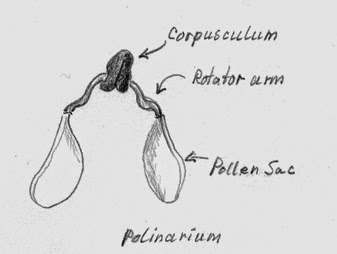
 These little sketches are adapted from the pictures in the book. In the upper one you see the typical Asclepias flower - just one, not the whole umbel - with the petals reflexed right back to the flower stem (and the sepals hidden underneath) to expose the business part of the flower to whatever bee, butterfly or beetle may be passing by. The 'hoods', which look like petals to us, hold nectar to entice the passing bee, butterfly et al. Between each pair of hoods is a slit in the central column. Each slit contains a  little body (shown in the lower sketch) called a 'pollinarium'.


Each pollinarium has a sticky pad, a 'corpusculum', which attaches the pollinaria to the column, and from which two 'rotator arms' extend. The pollen is collected in sacs at the ends of the arms. When an insect touches a corpusculum, it sticks to its body, and when the insect leaves, it pulls the pollinarium out of the small slit. The arms are called 'rotator arms' because they rotate when the arms dry in the open air, so as to get the pollinarium into position to get stuck into the next slit the insect visits. Typically, pollinaria get stuck on insects' antennae, and do not easily release until the insect has had time to move to a new flower.

One pollen sac contains enough pollen to fertilize an entire umbel. The pollen grains grow down the column hidden inside the slit, fertilize the ovules, and the distinctive Milkweed pod forms.

Turns out there are about 110 species of Milkweed in North America. There are only 3 in the Ottawa area, the Common Milkweed, Butterfly Weed (A. tuberosa) and Swamp Milkweed (A. incarnata) although there is some thought that a fourth, A. exaltata, may occur not very far south of here. As well, there is a species, A. sullivantii, which is extremely similar to A. syriaca, hybridizes with it, and also may occur in the southernmost parts of the Valley. It differs mainly and most obviously in being smooth, while A. syriaca is usually quite downy.

Common Milkweed is an 'early succession' plant, that is, it is one of the first species to move in and colonize open or disturbed ground. Sometimes it eventually gets crowded out by other species.

Until this year, Milkweed was on the Ontario Noxious Weeds list, which meant that you weren't supposed to encourage it.... luckily for us, and hopefully the Monarchs, this is being changed.